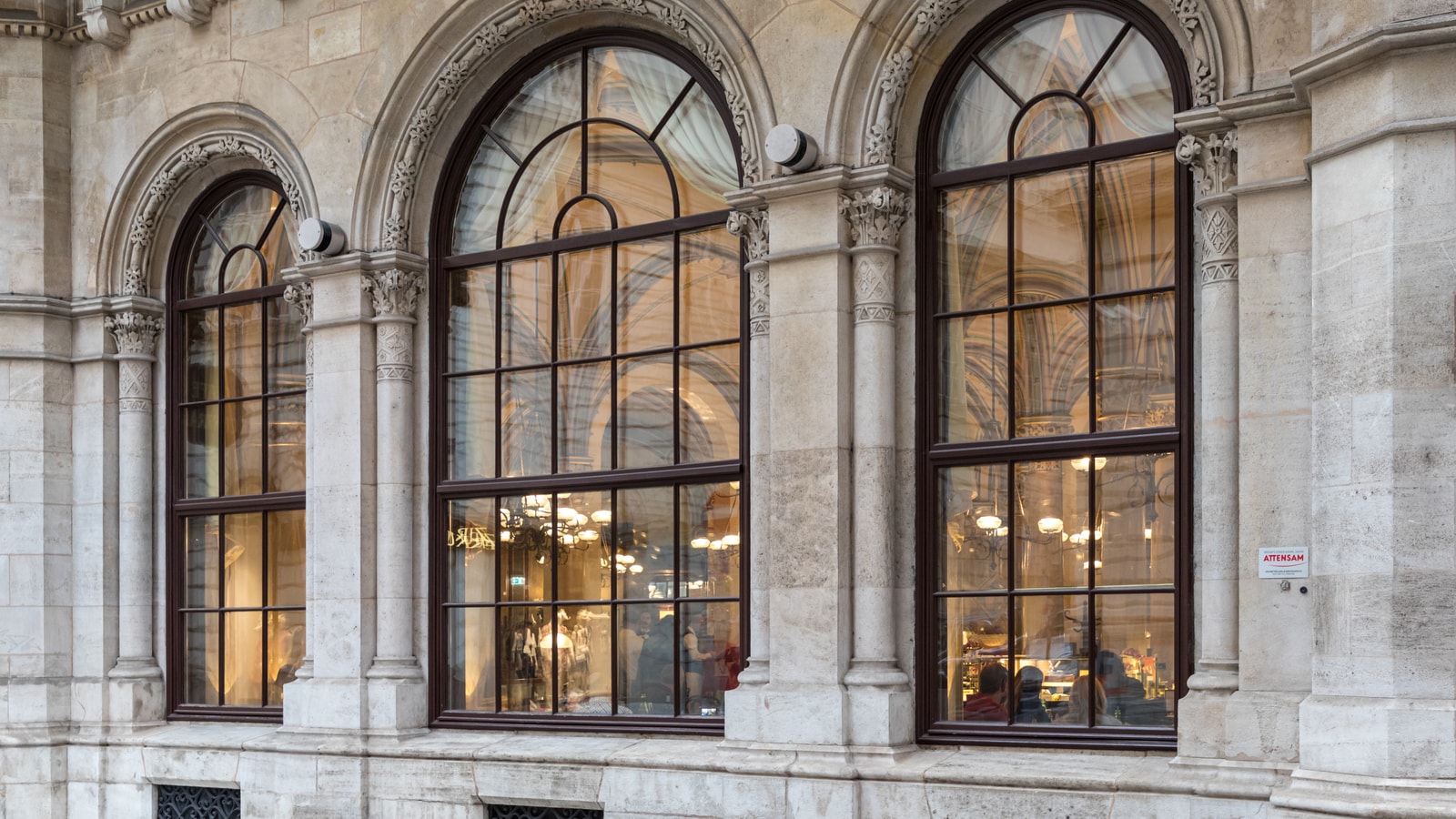
What it is
Café Central is a traditional coffee house at Herrengasse 14 in Vienna’s first district, on the ground floor of Palais Ferstel. It opened in 1876. It belongs to the tradition of the Viennese intellectual coffee house, but it is still a coffee house first: coffee, pastries, breakfast and light meals are the main business, and tea is a supporting drink rather than the reason the room exists.
History
Palais Ferstel was designed by Heinrich von Ferstel and originally housed a bank and stock exchange; the café occupies its ground floor. After opening in 1876, Café Central became a meeting place for Viennese intellectuals, writers, artists and political exiles in the late nineteenth and early twentieth centuries. The familiar list includes Peter Altenberg, Theodor Herzl, Alfred Adler, Egon Friedell, Hugo von Hofmannsthal, Anton Kuh, Adolf Loos, Leo Perutz, Robert Musil, Stefan Zweig, Alfred Polgar and Leon Trotsky. Such a list shows that the café was a node in literary and intellectual networks; it does not mean that these people were all there at once, or that every conversation can be reconstructed.
Because chess was played on the first floor, the café also acquired the nickname “the chess school” (Die Schachhochschule). A frequently repeated anecdote from before the First World War has the Austrian foreign minister Berchtold point to Trotsky in the café and ask who would lead the Russian revolution—“perhaps Mr Bronstein sitting over there at Café Central?” The story is useful for the political atmosphere of the time, but it should be read as an anecdote, not as minutes of a meeting.
The café closed at the end of the Second World War. In 1975, after Palais Ferstel was renovated, Café Central reopened in a different part of the building; it was fully renovated again in 1986. Today it is both a tourist landmark and a working part of Viennese coffee-house culture.
Space and tea
The room is defined by arcades, tall windows and the historic shell of Palais Ferstel, not by a tea-specific design. Service is built around the Viennese coffee repertoire: coffee, pastries, breakfast and light meals. Tea appears as an alternative drink; black tea, green tea, herbal infusions and mint tea may be available, but the exact list and method of service should be checked against the menu of the day.
If you arrive expecting a tea house, treat it instead as a Viennese coffee house where tea can be ordered. Decide first whether you want the coffee-house experience or a tea experience: for the room and its history, coffee is closer to the everyday life of the place; for tea, ask the server what black or herbal teas are available that day rather than assuming a fixed list.
Visiting
The address is Herrengasse 14 (the official site writes Ecke Herrengasse / Strauchgasse), 1010 Wien. In March 2026 the official site announced that Café Central would close from 16 March 2026 for comprehensive renovation and planned to reopen in autumn 2026. As of 25 November 2026, the page still showed the closure and renovation notice; there was no confirmation that the café had reopened. This page therefore records the status as closed, not operating. Check the official site before travelling, and do not rely on older guides. The notice also directs guests to DECENTRAL at Freyung 3/1 as a nearby temporary alternative.
Reading boundaries
Café Central matters as a public space in the history of the coffee house, not as the setting of a single unverified revolutionary story. The regulars, the chess games, the political anecdotes and the literary retellings should be kept apart: a list can show a social network, an anecdote can show how an era imagined itself, but neither replaces an archive. Turning the café into the place where Trotsky “planned the Russian revolution” compresses a complicated history into a scene. This page does not use that framing.