Overview
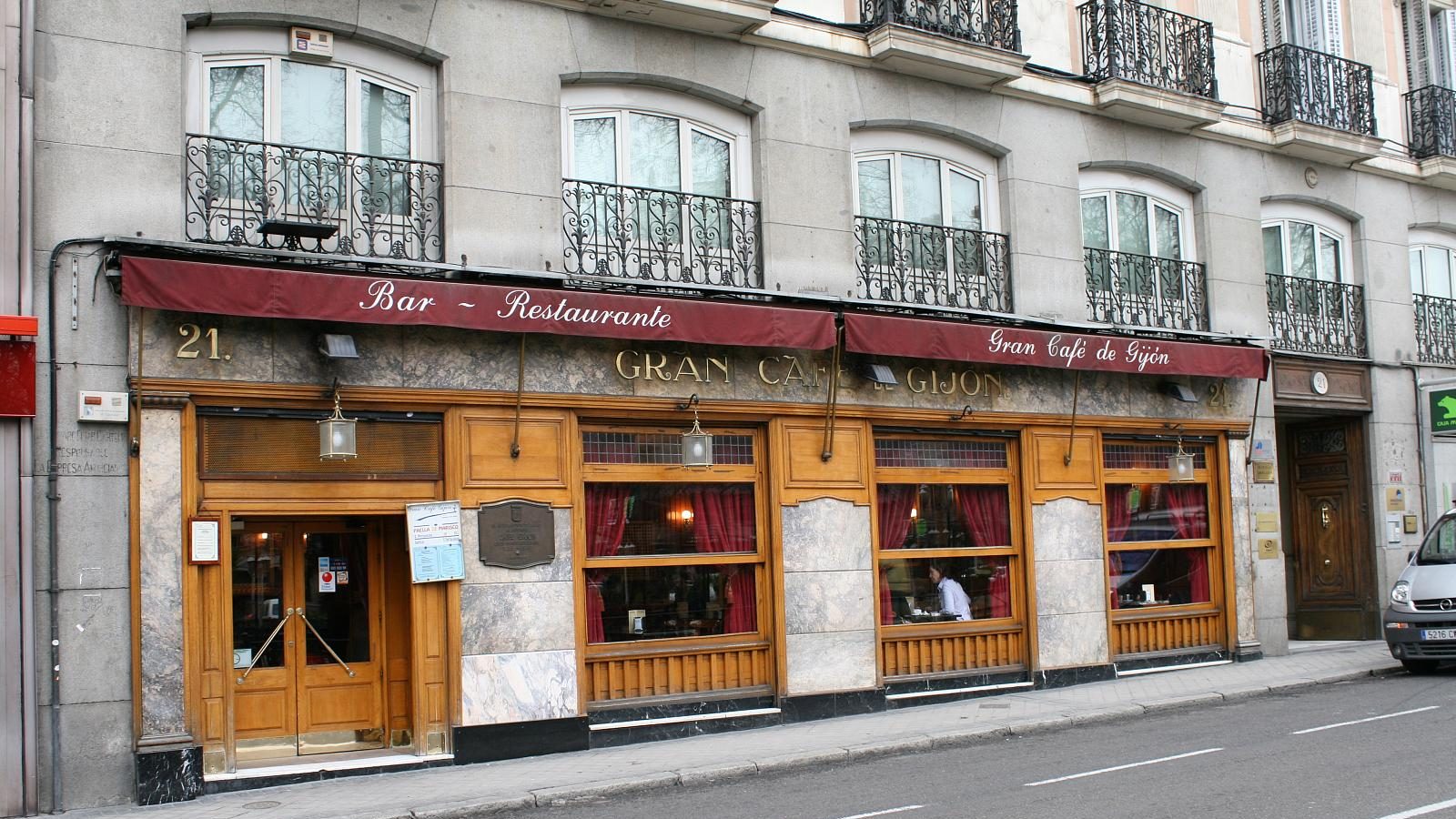
Café Gijón stands at 21 Paseo de Recoletos in Madrid and opened on 15 May 1888. It is one of the best-known cafés in the city’s literary tertulia tradition and one of the few old coffee houses still trading between the Prado and Recoletos avenues.
The exterior is brown marble with a wooden frame and three large windows; inside are black marble tables, a pomegranate-red and ivory chequered floor, mirrors and old pendant lights. It is a café, a restaurant and a literary memorial at once.
History
In 1888 Gumersindo García (some accounts say Gómez) opened the café on Recoletos. It began as a meeting place for the Madrid middle class and literary circles, and in the first half of the twentieth century became a centre of the tertulia, where writers, painters, actors and journalists debated literature and politics at regular tables.
In 1949 Fernando Fernán Gómez and other writers founded the Café Gijón novel prize in the café; the award became an important entry point in Spanish literature. Portraits and manuscript facsimiles of associated writers cover the walls.
At the end of 2025 the Escamilla family sold the café; in April 2026 it reopened as “Capucchino Grand Café Gijón”. The name, menu and management changed, while the address, the historic room and the name Gijón were kept.
Coffee and space
The menu is built around coffee, tea, breakfast, light meals and Spanish classics; this is not a tea-only room. The point of the space is staying: marble tabletops, the chequered floor, the trees of Recoletos beyond the windows and the dense literary memory on the walls. It suits reading, letters and long conversation, not a quick photo stop.
Visiting
Address: 21 Paseo de Recoletos, 28004 Madrid. Since the April 2026 reopening it trades as Capucchino Grand Café Gijón; hours and menu follow the new operator’s notices. Banco de España and Colón are the nearest metro stations.
Source boundary
Spanish-language sources give the founder’s surname as both García and Gómez; this page keeps both possibilities rather than forcing one. The sale in late 2025 and the reopening in April 2026 are the current state, not a “permanent closure”. Old details about a Nobel laureate’s fixed table or a novel written on the premises have no reliable source and are omitted.