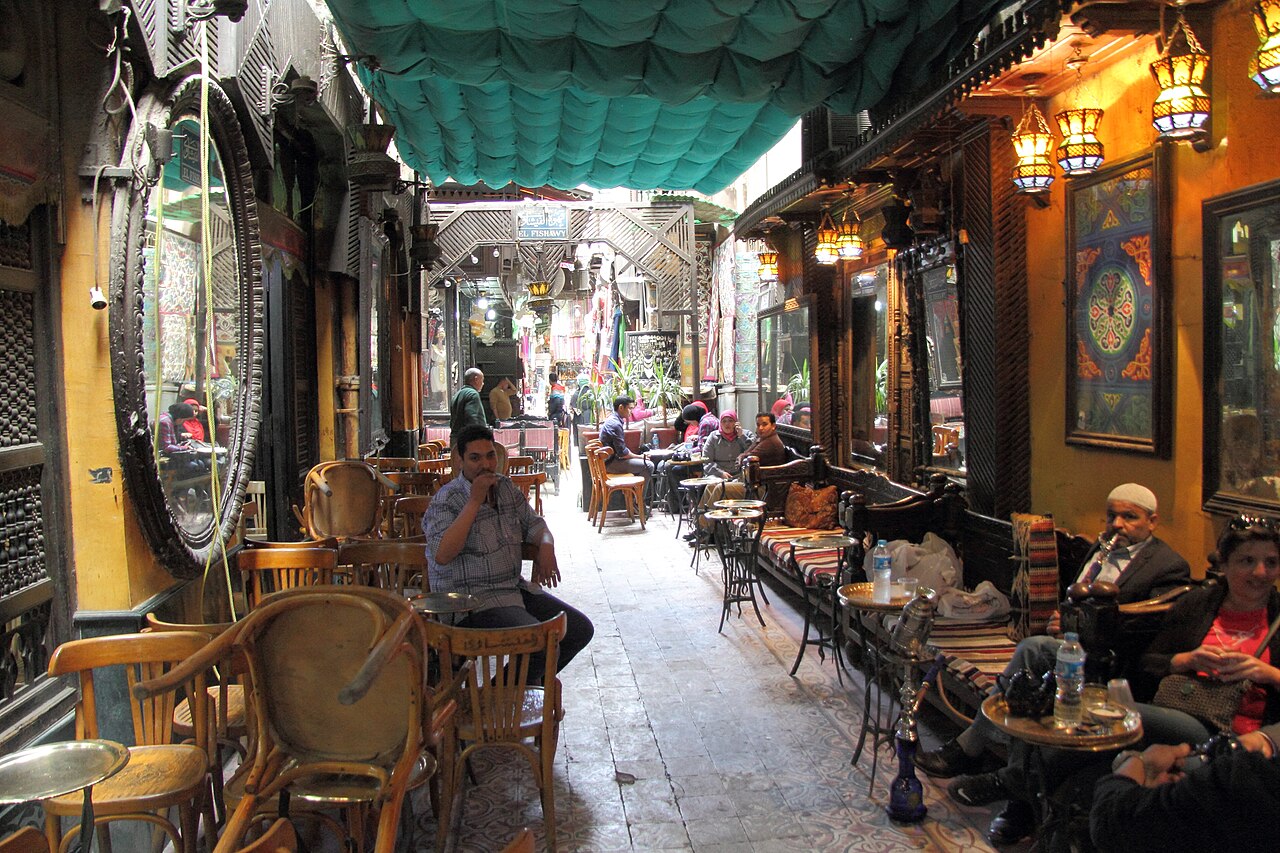
First, what kind of place is it?
El Fishawy sits in a narrow alley of Cairo’s Khan el-Khalili market. It is not a preserved “tea museum” but a working street café: mirrors, brass lamps, mashrabiya woodwork, low tables and waiters moving constantly through a cramped room. The space has been used across generations, and that use is part of what makes it legible.
Old places invite a particular mistake: treating age as proof. Founding dates, famous visitors and writing anecdotes are copied from one tourism page to another without primary evidence. The first useful question is not “how old is it?” but “who is telling this, and from what kind of record?”
The founding year: 1797 or 1773?
Middle East Eye dates the café’s opening to 1797, one year before Napoleon invaded Egypt. The Khan el-Khalili market website says it began in 1773 and has served for more than 240 years. The two dates differ by twenty-four years, and both appear on public websites. It is better to keep the disagreement visible than to choose one and call it fact.
What can be said with more confidence is that the café existed by the late eighteenth century, that it was opened by a founder remembered only as “el-Fishawy”, and that the Fishawy family has managed it for at least seven generations. The founder’s first name is lost. That gap belongs to oral tradition; it should not be filled in for narrative convenience.
From coffee stall to mirrored café
Middle East Eye records that the founder served Turkish coffee to friends after evening prayers. As the gatherings grew, he bought nearby buildings and established a venue, adding other drinks and shisha. This is a family origin story, not a day-by-day record. It places the café’s beginning in sociability rather than in a business plan.
In the twentieth century, the café became a gathering place for Cairo’s writers, intellectuals and public figures. The report names Naguib Mahfouz, Ahmed Zewail and King Farouk. Mahfouz won the Nobel Prize in Literature in 1988. The current proprietor recalls that Mahfouz liked to drink green tea while writing in the café, and “assumes” that most of the Cairo Trilogy was written there. The distinction matters: Mahfouz’s presence is supported by several sources; “most of the trilogy was written here” is the proprietor’s inference, not a verified writing history.
In 1986, Cairo authorities expanded the area around Hussein Square and swallowed most of the café’s space. The proprietor’s grandfather, Fahmy el-Fishawy, asked workers to install mirrors throughout the room — to enlarge it visually and to keep an eye on the space inside and outside. The mirror wall is therefore not simply an antique decoration. It is a response to shrinkage.
What people drink
- Shai bi Na’na’. Strong black tea with fresh mint and sugar, one of Egypt’s everyday tea drinks. It usually arrives in a glass on a metal tray with a sugar bowl. Watch how the tea is poured and where the mint sits; the proportions are a matter of habit, not a fixed recipe.
- Turkish coffee. Small cups, heavily brewed, with sediment. It is not identical to every “Arabic coffee” in grind, brew or serving. Avoid treating all dark coffee as the same drink.
- Shisha. Part of the café’s social furniture, not a synonym for tea. Availability, flavours and indoor rules vary by venue and by current regulation.
How to use the literary memory
The Khan el-Khalili website says Mahfouz set many stories in the market’s alleys. Middle East Eye says he was a regular in the twentieth century. These two claims can sit together without producing a third claim: that he completed a specific novel at a specific table. Literary memory is useful because it shows a space where different trades, classes and languages could overhear one another. It is less useful when turned into a plaque.
When you read “Mahfouz’s seat” or “the cradle of the Nobel Prize”, treat it as a narrative hook, not a conclusion. To discuss the relationship between writing and place, go back to biographies, interviews and editions, not only the sign at the door.
Visiting information
Address: Khan el-Khalili, El Gamaliya, Cairo, Egypt.
Operating status: the legacy record did not provide verifiable current information, and this page has not independently confirmed hours, prices or shisha policy. Check with local tourism information, telephone or an on-site visit before going. The market area is crowded; watch your belongings and ask about prices before ordering.
Sources and status
This page relies on Middle East Eye and two articles from the Khan el-Khalili market website. Middle East Eye supports the 1797 date, the seven generations, the lost founder’s name, the twentieth-century habitués and the 1986 loss of space. The market website supports the competing 1773 date, the mirrors and the bazaar’s history. The conflict is left visible rather than smoothed into a single timeline. Unsourced legacy claims — “never closed for a single day”, “six sultans and nine presidents” — have been removed. All migrated pages are currently marked reviewed, but sources and wording will continue to be revised.