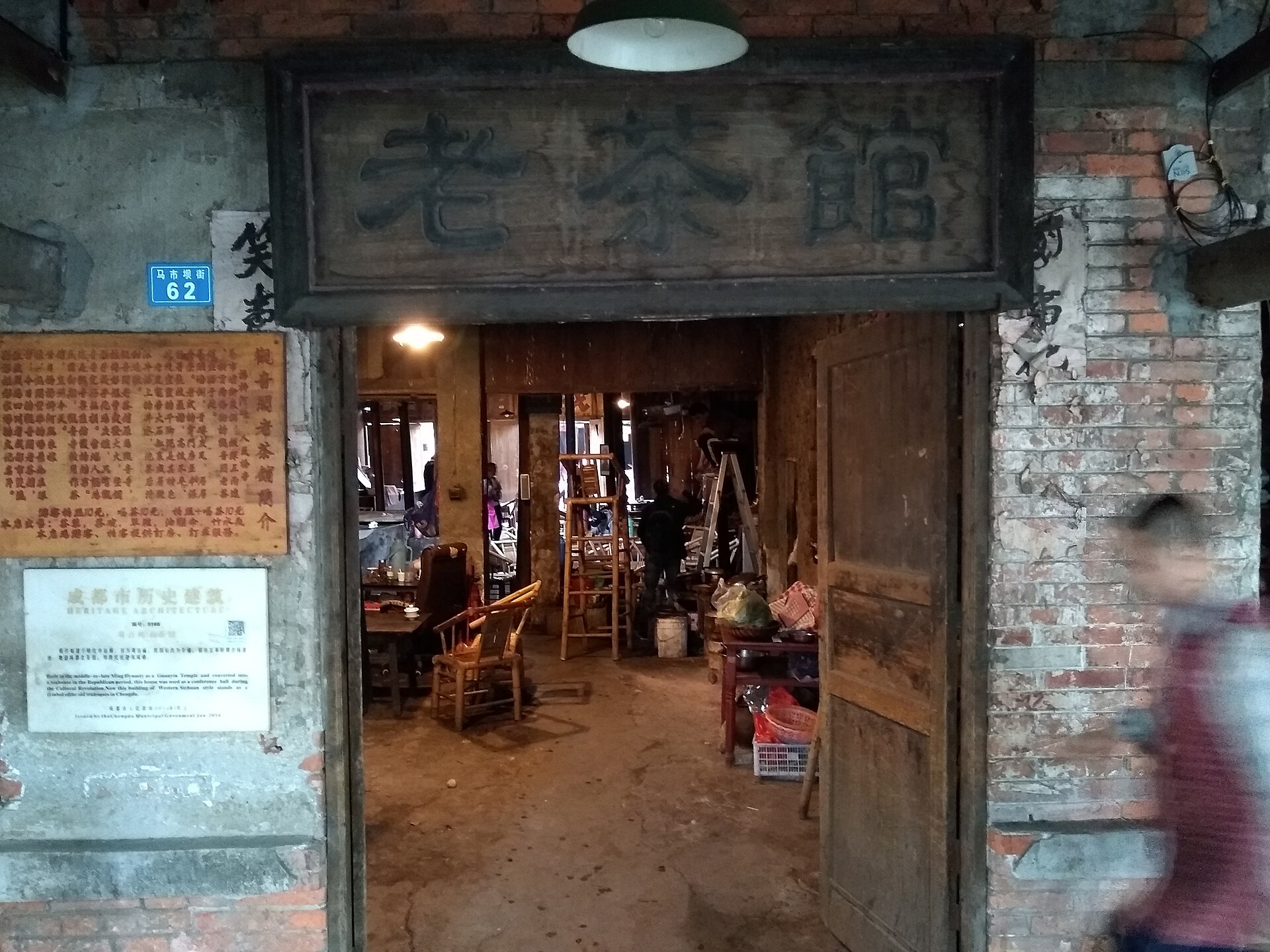
A building that still boils water
Guanyinge Old Teahouse stands at 64 Mashi Ba Street in Peng Town, Shuangliu District, Chengdu. Its value is not that it preserves an old building. It is that the old building still runs as a tea house: the tiger stove burns honeycomb coal, aluminium kettles send up steam, customers open the door, take tea and brew a gaiwan, and bamboo chairs wear hollows into the trodden-earth floor.
In 2016 it entered Chengdu’s fifth batch of protected historical buildings; in 2020 it was registered as a general immovable cultural relic in Shuangliu District. From November 2021 to April 2023, the district led a conservation project. In December 2024 the project received an Award of Merit in the UNESCO Asia-Pacific Awards for Cultural Heritage Conservation. The award means the place has been recognised. It does not guarantee that the tea is good.
From Guanyin shrine to tea shop
The Sichuan Provincial Gazetteer website, citing the Peng Town Gazette, traces the building to the Guanyin Pavilion, also called Zhishui Nunnery, built in the thirty-third year of the Qianlong reign. As traffic on the Yangliu River grew, merchants and pedlars stopped at the shrine to rest and drink tea; in time a tea shop formed. In the early Republic it became a tea shop proper, and it continued through collective management, contracting and private operation to the present.
The name “Guanyin Pavilion” has two local explanations. One says Peng Town suffered several great fires and this building alone survived, which residents read as the Bodhisattva’s protection. Another says a Guanyin statue being carried upstream fell into the river mud near the old bridge, was recovered and installed in the tea shop beside the bridge. Both are local legends, not architectural evidence. They explain why a tea shop carries a temple’s name.
Tiger stove and trodden earth
- The tiger stove. A large stove built of puddled earth, with honeycomb coal in its eyes and aluminium kettles lined across the top. The Sichuan Provincial Local Chronicles Office article, reprinted by The Paper, calls it the only old tea house in Sichuan with a preserved tiger stove. That “only” is the article’s formulation and should be quoted with its source.
- The trodden-earth floor. Not concrete and not ordinary mud, but earth compacted and hollowed by generations of shoes. It is bad for high heels and worse for wheeled luggage.
- Bamboo-and-mud walls. Where the plaster has fallen, bamboo lacing and yellow earth show through. The 2021–2023 repair used traditional methods rather than covering the walls with modern paint.
- Bamboo chairs and square tables. The chair backs are low and creak with age; the tables are small, just enough for a gaiwan, sunflower seeds and a cigarette pack. The scale suits conversation, not laptop work.
- Images on the walls. Public notices, slogans and portraits from different periods remain. They are layers of the room’s history, not a single “nostalgia set”. Distinguish original material, painted sets and later additions.
A bowl of sanhua tea
Regulars usually drink jasmine sanhua; most visitors do the same. CCTV reported that regulars paid 1 yuan and visitors 10 yuan in 2024. That is a reported price at that moment, not a permanent tariff. Many bowls have chips; regulars recognise their own by the chip. It is not an aesthetic of poverty but a mark left by long use.
The procedure is plain: take a bowl, add tea, pour water, find a seat. The tiger stove keeps boiling, so refills do not require calling a server each time. If you want to photograph, buy tea first; if you want to sit outside, the plane trees are cooler than the room. Confirm current hours and prices on site.
Visiting information
Address: 64 Mashi Ba Street, Peng Town, Shuangliu District, Chengdu.
Operating status: this page has not independently verified current hours or prices. Reports say regulars open the house before 5 a.m. and it serves through the day, and that it reopened after the 2023 restoration. Check local information before travelling. The interior is dark and the floor uneven; when photographing, do not block regulars or the aisle.
Sources and status
This page relies on the Sichuan Provincial Local Chronicles Office article (reprinted by The Paper), CCTV, People’s Daily Sichuan and the provincial historical-building list. That article supports the Guanyin Pavilion origin, the Qianlong date, the Republican conversion, the tiger stove and the regulars’ self-service. CCTV supports the 2024 UNESCO award, Li Qiang’s 1995 takeover, the 1-yuan/10-yuan prices and the 2021–2023 conservation. People’s Daily supports the trodden-earth floor, bamboo-and-mud walls, sanhua tea and three generations of management. The provincial PDF supports the historical-building status and the number 64 address. Unsourced legacy claims — “300 years of history”, “roof tiles did not fall in the 2008 earthquake”, “the portrait keeps the place safe” — have been removed. All migrated pages are currently marked reviewed, but sources and wording will continue to be revised.