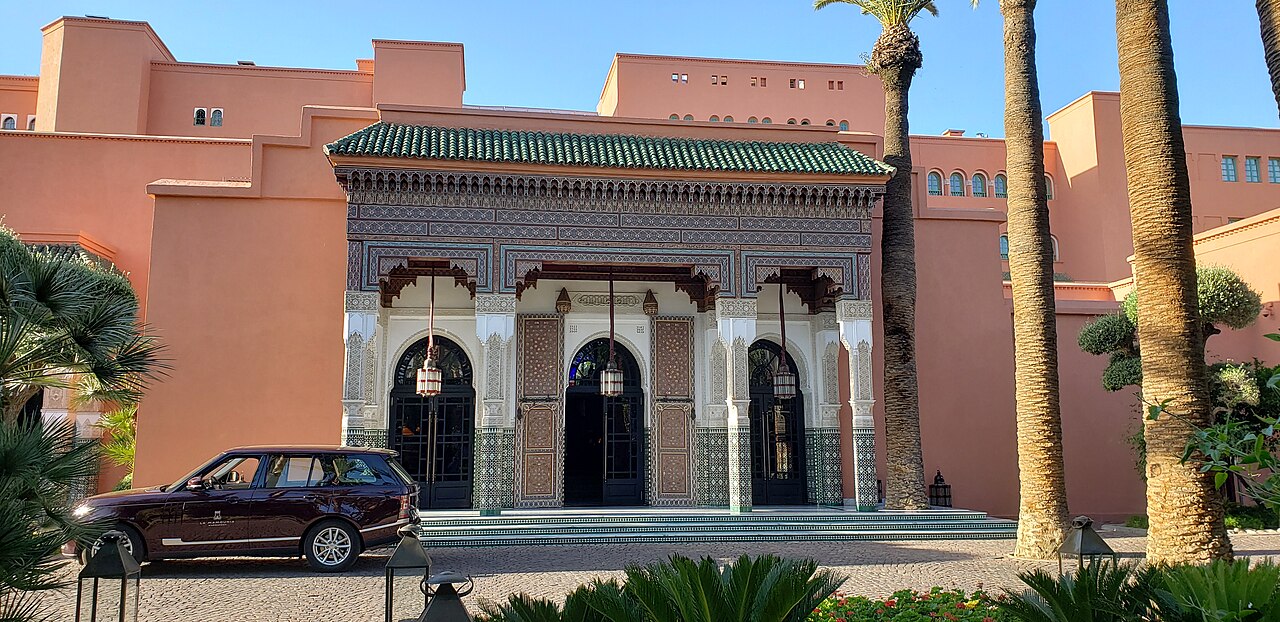
Begin with a garden
The story of La Mamounia begins in the eighteenth century. The hotel’s official history records that the Alaouite Sultan Sidi Mohammed Ben Abdallah gave his son, Prince Al Mamoun, a thirteen-hectare orchard as a wedding gift. The prince turned it into a leisure ground for garden parties. The hotel stands on that garden’s historical site.
The name is usually explained as “the place of Mamoun”. Tourism copy tends to turn such names into romance. A more careful reading begins with something concrete: a walled orchard with irrigation, shade and a boundary. Only later does the name refer to a hotel built inside that former garden.
From railway hotel to palace
In the twentieth century, the Moroccan Railway Company decided to build a hotel on the site. French architects Henri Prost and Antoine Marchisio designed a building that combined Moroccan architectural vocabulary with Art Deco. Traditional zellij tilework and Berber tapestries sit beside Art Deco furniture. The hotel’s own history describes this as a marriage between Western comfort and Eastern splendour.
The year 1923 is the starting point of the hotel’s historical narrative. Exact opening dates, original room counts and later renovation chronologies differ between sources. This page uses only what the hotel itself states and avoids details such as a specific opening tea party in November 1923, which cannot be checked.
Winston Churchill recurs in the hotel’s history. The official account says he spent winters there, put aside his statesman’s suit for watercolours, and moved from balcony to balcony chasing the light. The hotel later named a bar and a suite after him. This shows that the hotel became a winter residence for European public figures in the first half of the twentieth century. It does not prove that Churchill ordered a particular mint tea in a particular tea room.
The two tea rooms today
The hotel currently lists two Pierre Hermé tea rooms: Le Salon de Thé and Le Menzeh. One is in the Andalusian patio, the other in the gardens. The hotel’s description concentrates on pastry and afternoon tea rather than on an ancient Moroccan tea ritual: macarons, madeleines, desserts inspired by Moroccan culinary heritage, and afternoon-tea combinations that can include champagne.
This does not mean there is no Moroccan mint tea. It means that if you want to read everyday Moroccan mint tea, you should look at old-city teahouses, homes and markets. La Mamounia offers a tea-room experience inside a palace hotel. The two share tea, mint and sugar, but they are not the same social scene.
Confusing them produces two common misreadings. One treats the hotel tea room as “the ultimate temple of Moroccan tea culture”. The other treats every item on the menu as “traditional tea food”. More useful questions are: who drinks here, why, at what price, in what clothes, and for how long? The answers locate the experience socially.
What to look at in the space
- Zellij and textiles. Look at how geometric tilework covers a wall, then at how Berber weaving meets Art Deco furniture. These are not merely “exotic decoration”; they are different craft traditions negotiating one room.
- Garden and patio. The official tea-room page places tea in two settings: the gardens and the Andalusian patio. Watch how light, tree shadow and water organise coolness and shade.
- Pastry and tea menu. Pierre Hermé’s menu places macarons and madeleines beside Moroccan ingredients. Ask which items are explicitly “in homage to Moroccan culinary heritage” and which are French pastry technique.
- Dress and threshold. The FAQ requires elegant attire in all restaurants and bars and forbids plastic sandals and flip-flops. Non-resident guests may visit the restaurants and bars. These rules are part of the experience, not irrelevant detail.
Visiting information
Address: Avenue Bab Jdid, Marrakech 40040, Morocco.
Operating status: this page has not independently verified current opening hours or reservation status. The hotel website lists tea rooms and restaurants, but visitors should confirm same-day opening, dress code and booking rules through the official site or telephone. A historical introduction is not a promise that a given tea room is open.
Sources and status
This page relies on La Mamounia’s official history, tea-room page and FAQ. The history page supports the garden’s origin, the architects and the combination of Moroccan architecture with Art Deco, and Churchill’s stays. The tea-room page supports the two current Pierre Hermé tea rooms and their pastry direction. The FAQ supports the dress code and access rules for non-resident guests. Unsourced legacy details — the opening tea party, famous guests’ tea habits and “heritage listing” claims — have been removed. All migrated pages are currently marked reviewed, but sources and wording will continue to be revised.