What it is
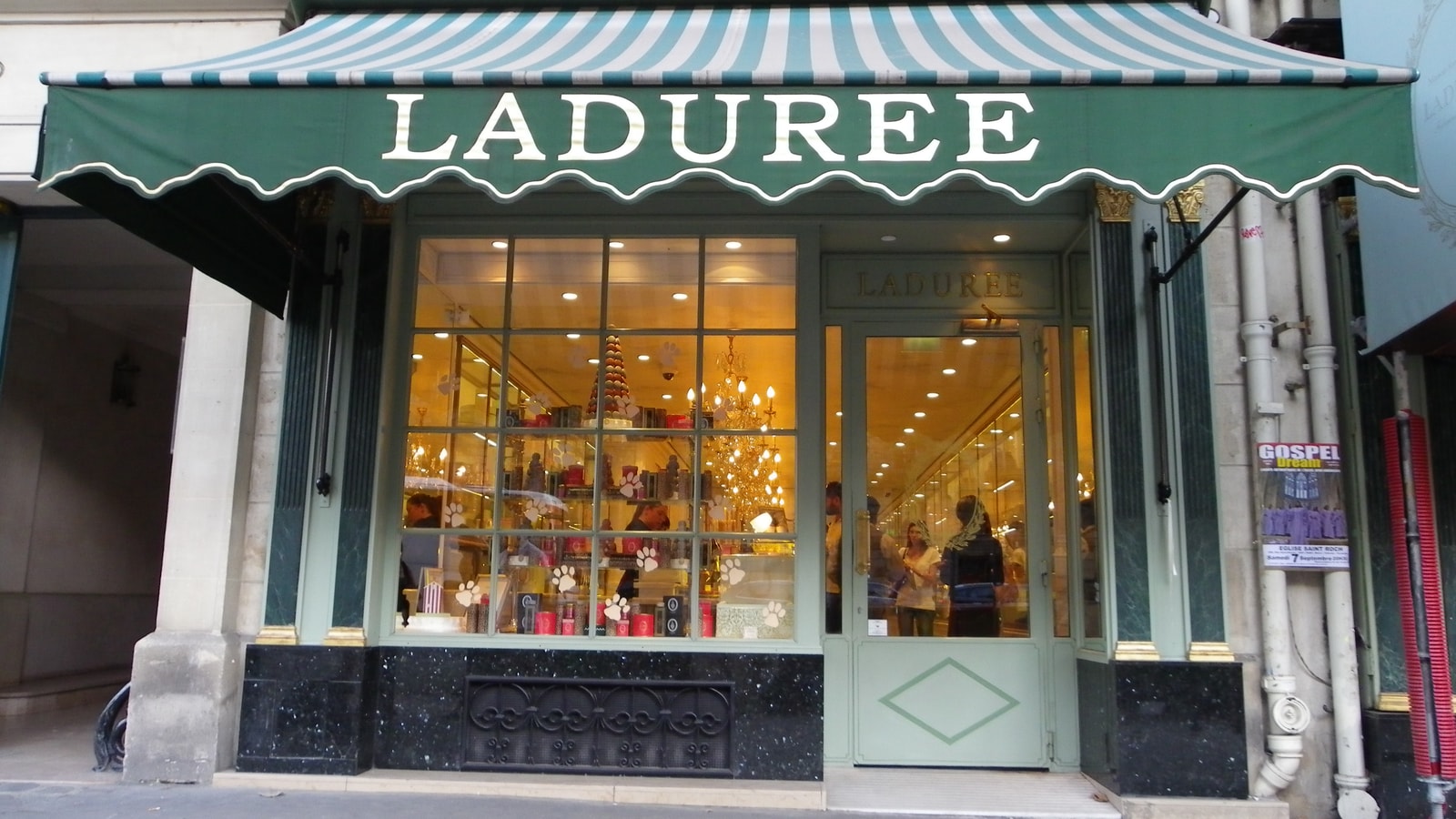
Ladurée is a Paris pastry and tea-room house at 16 Rue Royale, founded in 1862 by Louis Ernest Ladurée. It now has shops in many countries, but this page focuses on the Rue Royale original and the brand’s history. It is not a Chinese-style tea house; the tea list exists mainly to serve French pastry, macarons and salon-style drinking.
History
Louis Ernest Ladurée was a miller by trade and opened a bakery on Rue Royale in 1862. During the Paris Commune in 1871 the bakery was burned; the same address was later rebuilt as a pastry shop. The interior decoration was entrusted to Jules Chéret, whose ceiling paintings of plump cherubs dressed as pastry cooks became part of the identity of the house. The shopfront and interior were painted in the pale green that remains Ladurée’s most recognisable visual signature.
In 1930, a distant relative of the family, Pierre Desfontaines, put cream ganache between two macaron shells to make the double-decker macaron familiar today. This was not the invention of the macaron biscuit itself—France already had an older almond-biscuit tradition—but a new way of combining two shells with a filling. Ladurée later turned that form into a brand emblem.
In 1993 Groupe Holder acquired Ladurée, and the business moved from a single Rue Royale shop towards a chain and an international brand: shops opened on the Champs-Élysées and at Le Printemps Haussmann in 1997, on Rue Bonaparte in 2002, and in Harrods in London in 2005. In 2022 a majority stake passed to Stéphane Courbit. Brand expansion and ownership changes are a separate timeline from the “1862 shop”; the two should not be merged.
Space and tea
The Rue Royale shop is not a tea warehouse. Its interest lies in the combined pastry shop and tea-room format: the pale-green façade, the macaron towers in the window, mirrors and ceiling decoration, and the salon-style seating. Tea is usually served with a pastry set, an afternoon tea, or as a single drink. Common categories include black tea, flavoured black tea, green tea and herbal infusions; the exact list, brands and prices vary by shop and season, so this page does not fix a single blend.
Macarons are sweet, with a light shell and a moist filling. For tea, an unsweetened black tea or Darjeeling is usually a better balance than a flavoured blend; if you choose rose, vanilla or fruit-flavoured tea, check its sweetness first, or the tea and pastry will compete. It is more accurate to treat Ladurée as a French pastry destination than as a tea-tasting room.
Visiting
The address is 16 Rue Royale, 75008 Paris, in the eighth arrondissement, near the Place de la Concorde and the Madeleine area. The official site provides brand, shop and current service information. This page records the status as operating because the official site still presents the brand and its shops as active; that does not promise that every shop is open every hour. Queues are likely at popular times. Check the official shop page before visiting, especially if you want to sit down for tea rather than buy a box of macarons.
Reading boundaries
Three claims are easy to confuse at Ladurée: the 1862 bakery, the pastry shop rebuilt after the 1871 fire, and the 1930 double-decker macaron. The first is the starting point, the second is the change of space and business, and the third is the key to the macaron brand story. Calling the double-decker macaron “the invention of the macaron” erases the older almond-biscuit tradition; treating every global shop as “the 1862 original” erases the expansion. This page states the relationship among the three layers and does not add another layer of brand mythology.