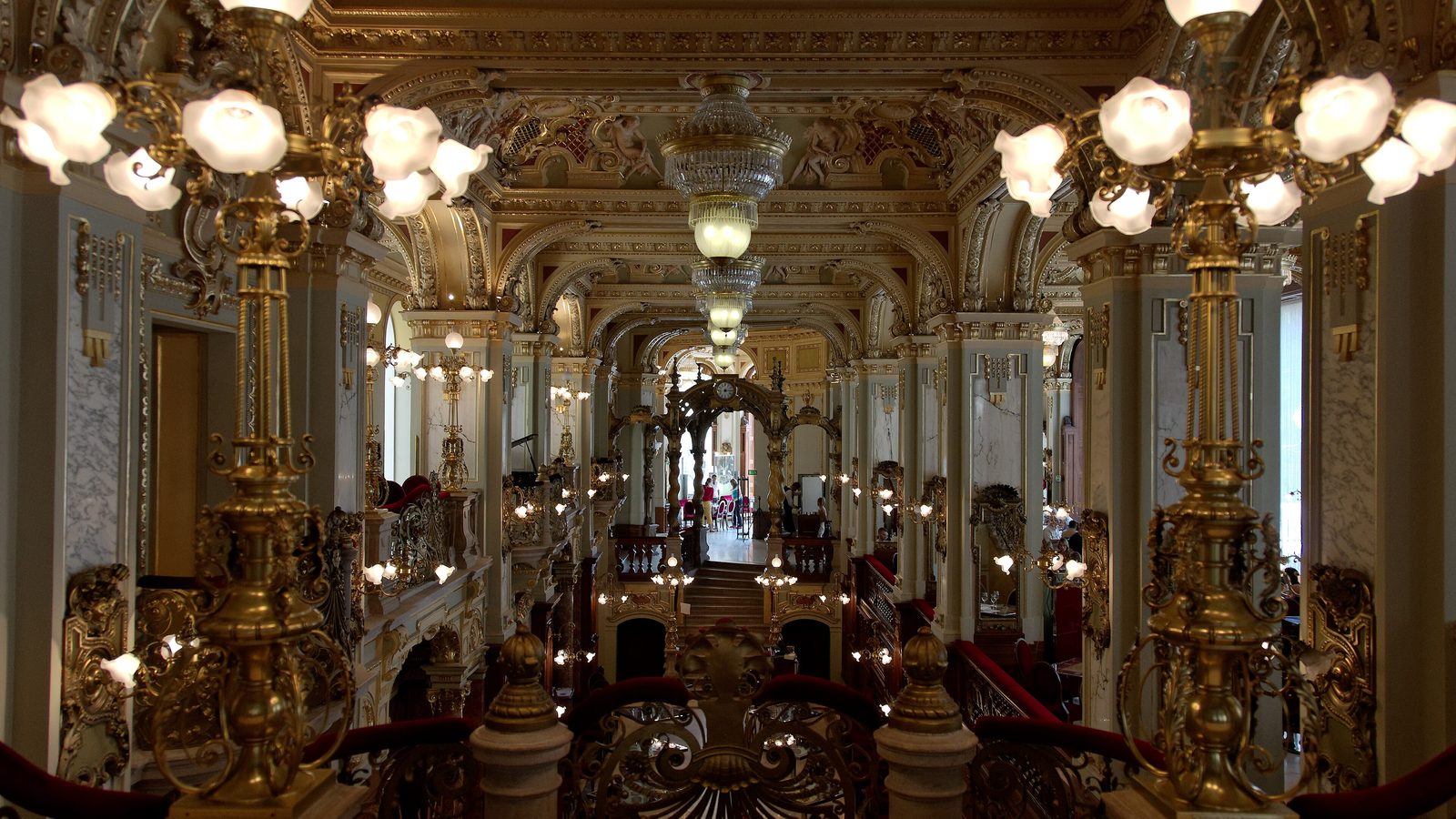
Overview
New York Café (New York Kávéház) stands at 9–11 Erzsébet körút in Budapest’s District VII, on the ground floor of the New York Palace. It opened on 23 October 1894 and is one of the best-known spaces in Hungarian coffee-house culture. The “New York” in its name refers to the New York Life Insurance Company, not to New York City.
The café is known for marble columns, gilded ornament, frescoes, chandeliers and a long arcade. It now belongs to the Anantara New York Palace Budapest Hotel and is both a dining room and one of the most photographed interiors in the city.
History
The New York Palace was designed by Alajos Hauszmann with Flóris Korb and Kálmán Giergl, built between 1891 and 1894 as the Hungarian headquarters of New York Life. The ground-floor café opened with the building on 23 October 1894 and quickly became a meeting place for writers, poets, editors and artists; the gallery upstairs housed newspaper offices.
The twentieth century brought repeated political and urban change. After the Second World War the café declined and was used for a time as a sports goods shop; it reopened as Hungária in 1954 but did not recover its full prewar decoration. A major restoration completed in 2006 rebuilt the gilding, frescoes and spatial layers from historical photographs and drawings. It now operates with the hotel.
Coffee and space
New York Café is first a coffee house, not a specialised teahouse. The menu draws on the multi-ethnic cooking of the Austro-Hungarian monarchy, with Hungarian goulash, fisherman’s soup, paprika chicken and Wiener schnitzel alongside Dobos, Sacher and Eszterházy cakes; coffee, tea and wine are all served.
The room is more famous than the menu. Marble columns divide the long hall, frescoes and gilding cover the ceiling, and rows of chandeliers keep the light low; the fourteen faun sculptures above the entrance were made by Károly Senyei. Live piano and Roma music keep it a working coffee house rather than a silent museum.
Visiting
Address: 9–11 Erzsébet körút, Budapest 1073. Monday to Wednesday 7.00–24.00, Thursday to Sunday 7.00–01.00; dinner reservations are advised after 18.00, while daytime seating is usually by arrival. Hours and reservation rules follow the official page.
Source boundary
The story that the key was thrown into the Danube at the opening so the café could never close is a Budapest legend, and the official site tells it as a legend; this page does not turn it into history. “The most beautiful café in the world” comes from awards and marketing, not a measurable architectural judgement. The 2006 work was a reconstruction from historical records, not the preservation of every old fitting, and the page says so. Old anecdotes about a particular writer finishing a particular book at a particular table have no reliable source and are omitted.