Overview
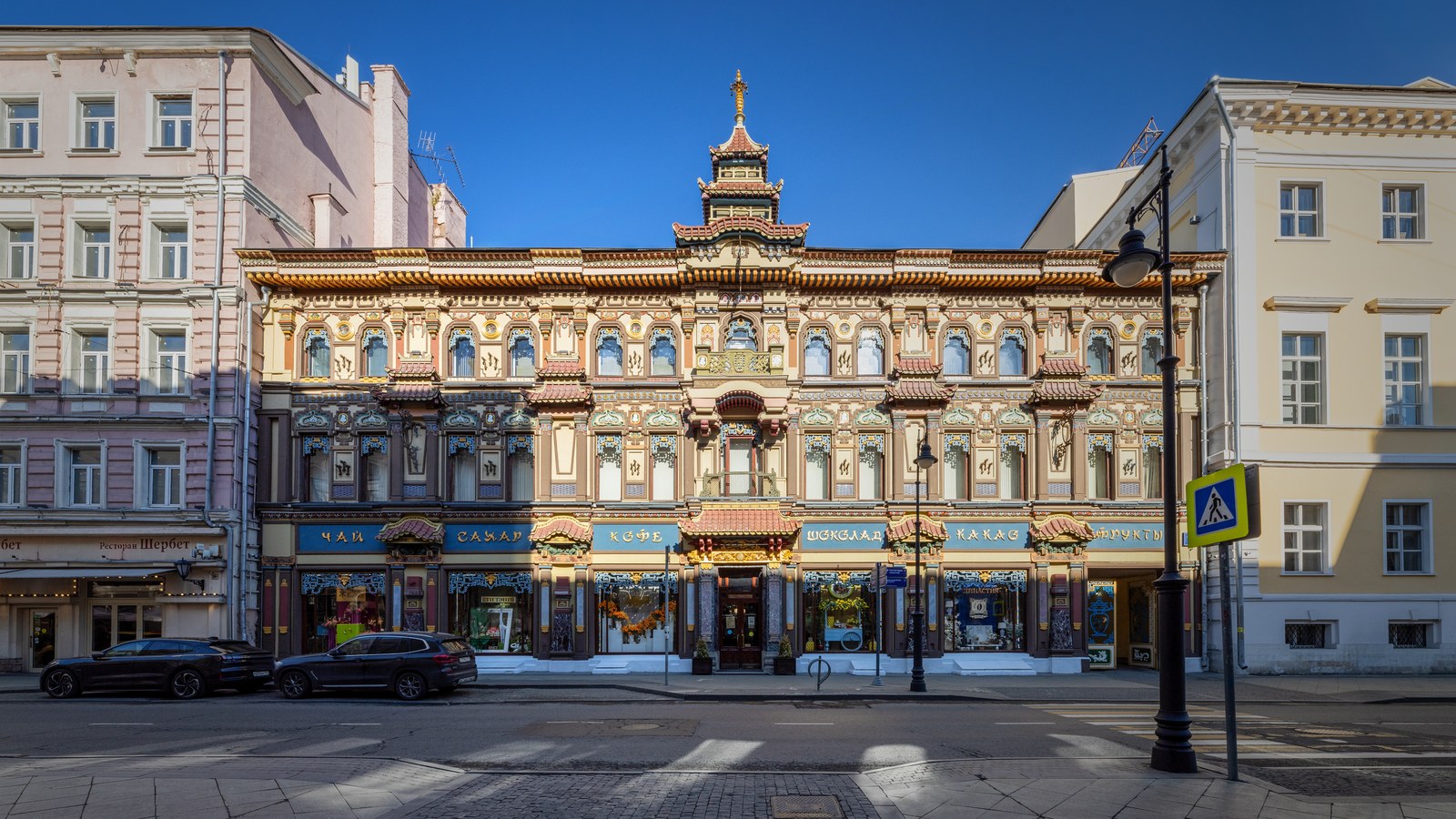
The Perlov Tea House (Чайный дом Перлова) stands at 19 Myasnitskaya Street in central Moscow, a short walk from Red Square and Lubyanka. Its most recognisable feature is not the tea list but the facade: a green roof, coloured tiles, a Chinese-style porch and ornamental details that make it look like a tea pavilion transported to a Moscow street.
The building was constructed in 1890–1893 by the architect Roman Klein as the office and shop of the Perlov family tea business. In 1895–1896 the facade was remade in the Chinese style visible today. It now operates mainly as a tea and coffee retailer, not as a teahouse offering a full Chinese-style seated tea ceremony.
History
The Perlov family was a major tea merchant in the late Russian Empire. In the late nineteenth century the Moscow tea market connected the Kyakhta overland trade with consumers in European Russia; the Perlov firm built wealth along that chain and needed a headquarters that expressed its position.
In the early 1890s the family commissioned Roman Klein to design the new building. Klein later designed the Pushkin Museum of Fine Arts, among other Moscow landmarks, and was a favoured architect of the period. The three-storey building was completed in 1893. In 1895–1896 the facade was remodelled with a green roof, an ornamental entrance and Chinese-style motifs. The timing was close to the 1896 Moscow visit of the Qing statesman Li Hongzhang for the coronation of Nicholas II.
The claim that Li visited the Perlov Tea House is a story that needs correcting. Li did visit Moscow in 1896 and did go to a tea shop run by another Perlov brother, but the building at 19 Myasnitskaya Street was not that shop. This distinction separates architectural history from diplomatic anecdote: the Chinese-style facade may reflect the contemporary taste for chinoiserie, but it does not justify placing a real visit in this building.
After the October Revolution of 1917 the firm was nationalised and the building passed through several uses. In the Soviet period tea retail and the shop were absorbed into the state system, and the building suffered from long use and wear. From 1998 the building underwent a restoration lasting about twelve years, and in 2012 the tea and coffee shop reopened as a retailer, becoming a historic building on Myasnitskaya Street that is still in use.
Tea and space
Today the Perlov Tea House is primarily a shop. Shelves carry loose-leaf tea from China, India and Sri Lanka, along with coffee, teaware and gifts. The historic staircase, ceilings and some decoration remain, but the route is "enter, choose tea, pay" rather than "sit down, order tea, linger".
The facade is the part worth studying. Chinoiserie in eighteenth- and nineteenth-century Europe was a decorative language, not a record of actual Chinese architecture. The Perlov firm applied that language to a tea merchant house, which shows how the tea trade turned "Eastern imagination" into a commercial streetscape.
A visitor expecting a teahouse will be disappointed. A visitor treating it as "an architectural specimen of the tea-trade era plus a working tea shop" will find it coherent. Buying a tin of tea, looking at the facade and walking a stretch of Myasnitskaya Street is the more appropriate way to visit.
Visiting
Address: 19 Myasnitskaya Street, Moscow 101000, Russia. Status: operating, mainly as a tea and coffee retailer. Checked on 25 November 2026.
Current opening hours, whether seated tea is available, and the range of services should be confirmed with the official merchant on the day. The facade can be viewed from the street, but inside the shop visitors should follow its shopping and photography rules.
Source boundaries
This page uses the official Perlov merchant page, the Moscow heritage project "Узнай Москву" and the Москва Прогулка research to support the 1890–1893 Roman Klein building, the 1895–1896 Chinese-style remodelling, the 1917 nationalisation, the 1998–2012 restoration and the correction that Li Hongzhang did not visit 19 Myasnitskaya Street.
Older copy about Li "tasting tea and writing an inscription" in the shop, a tsar or nobleman ordering a special blend, or court tea wares being kept inside lacks an evidence chain in these three sources and is not repeated. The Chinese-style facade is a fact of decorative history; it should not be equated with "a tea shop run by Chinese owners" or with a Chinese tea ceremony.